LAUNCH OF STANFORD SEED WEST AFRICA CENTER.
The Stanford Institute of Innovation in Developing Economies has launched the Stanford SEED West Africa Center here in Accra at the plush Airport Residential Area. The launch was done at the College of Physicians and Surgeons in Accra on the 18th July, 2013. In his opening remarks and introductions, Mr. J. Kofi Bucknor, Managing Partner, Kingdom Zephyir Africa Management stressed the need for Africa to unearth the talents of entrepreneurs. Dr.Tralance Addy, Executive Director, SEED demonstrated the vision of SEED for Africa. He mentioned among other things that the Centre will serve as a focal point for interactions with local institutions, entrepreneurs, policy makers, investors, and other stakeholders to facilitate the development of robust ecosystems that support innovation and business growth. The Centre will also serve as an ideal point of research in entrepreneurship and innovation to impact the development and implementation of policies as well as provide guidance for both business leaders and entrepreneurs. SEED’s programs targets sectors like Healthcare, Food and Nutrition, Education, Energy, Water, and ICT. SEED seeks to integrate intellectual and financial resources with local action to help bring change that positively impacts national growth and individual livelihood.
Key faculty members for SEED include Dr.Tralance Addy, Executive Director, Prof. Hau Lee, SEED Director, Research, Thoma Professor of Operations, IT at Graduate School of Business. Prof. James Patell, Faculty Director, Product and Service Innovations, Herbert Hoover Professor of Public and Private Management and Prof. Jesper Sorenser, Faculty Director, Entrepreneurial Leadership, Robert A. and Elizabeth R. Jeffe, Professor of Organizational Behavior. The first session of the Centre will start from July 2013- January, 2014 whilst enrollment for the second academic year will commence in January, 2014. Story By, Malise Otoo. Principal Correspondent, African Review Magazine. THE YALE CLUB OF GHANA PRESENTS FROM SUCCESS TO SIGNIFICANCE. The conference took place from the 18th to 19th July, 2013 at the Movenpick Hotel here in Accra, Ghana. Opening Welcome and remarks were done by Jeannine Scott, President, U. S- Angola Chamber of Commerce, Founder and Principal America to Africa Consulting (A2A), LLC, and Association of Yale Alumni Board of Governors. Rodney Cohen, Assistant Dean and Director Afro-American Cultural Center at Yale. Mark Dollhopf, Executive Director, Association of Yale Alumni. There was a panel discussion on the topic, ‘’Education for Africa, in the 21st Century and Beyond”. Panel members included, Prof. Ernest Aryeetey, Vice Chancellor, University of Ghana, Kimberly Goff-Crews, Secretary and Vice President for Student Life, Yale University. Mehitabel Markwei, President, Yale African Students Association and Margaret Nkrumah, Former Vice President, SOS-Kinderdorf International. The moderator was Ruth Botsio, Barrister-at-Law, AYA At-Large Delegate. When a question on,” How ICT can be used to enhance education in Africa?” Dr. Margaret Nkrumah said, “I am not sure it can but, I hope it does, because teachers in Africa are not adaptable to ICT or even technology”. She went further to mention that young people must be empowered to be creative and innovative because, “Youth have passion, energy and drive and key have the power to change the world.” During the governance section, the panel consisted of Nene Amegatcher, President, Ghana Bar Association, Franklin Cudjoe, Founder and Executive Director, IMANI Center for Policy Education, Prof. Audrey Gadzekpo, Associate Professor, University of Ghana. Chris Fomunyoh, PhD, Senior Associate for Africa, National Democratic Institute for International Affairs and Bisa Williams, US Ambassador, Niamey, Republic of Niger. The moderator was Ken Ofori-Atta, Co-Founder and Chairman, Databank Limited. It was mentioned that, “If Ghana missteps, the rest of Africa missteps with it”. In explaining this, however, Nene Amegatcher observed that, “The framers of the 1992 constitution vested so much power in the Presidency that it makes the President virtually a dictator.” He also advised that the winner takes all syndrome must be checked. The Presidents have been very powerful based on certain statutes by Parliament. An example is the Presidential Transition Act. “The powers given to the Presidency is too much and therefore too dangerous.” He says. Again, the media was put on its toes by Prof. Audrey Gadzekpo, Associate Professor at the University of Ghana and a communicative expert. When the issue was raised about America’s foreign policy towards African Countries, Madam Bisa Williams says America policy towards Africa is that of Networking, Economic Growth in Africa, Investing in the next generation of Africa, Democracy, Food Security and Infrastructural Development. She pointed out President Obama’s second and recent visit to Africa and launch of a $20 billion energy initiative dubbed, POWER AFRICA. There was a Gala dinner and Silver Boone Lecture with Taiye Selasi, Author/Filmmaker, Ghana Must Go. Taiye was interviewed by Nicholas Roman Lewis, Sr. Director Shared Interest Groups AYA, Principal, the Roman Group. There were various discussions on Business and Entrepreneurship, Community Impact and Social Responsibility, Technology, Media and Telecommunications as well as International Health Collaborations. -Story By, Malise Otoo. MTN GHANA ORGANISES BLOOD DONATION EXERCISE IN THREE REGIONS TO MARK VALENTINE’S DAY CELEBRATION. MTN Ghana has held a nation-wide blood donation exercise in Accra, Kumasi and Takoradi with the hope of securing 500 pints of blood for the National Blood Bank, the Effia Nkwanta, Komfo Anokye, and Ridge Hospitals blood banks. This year’s exercise was unique because it was done simultaneously across the country and although MTN Ghana has held blood donation exercise in the past, this year’s donation was crucial and it comes at a time when alarming reports have emerged of acute shortage of blood at the National Blood Bank at the Korle-Bu Teaching Hospital. MTN Ghana Foundation organizers of the event, appealed to members of the public to come out in their numbers to express their love on Valentine’s Day by donating a pint of blood to help save a life. In Accra, the exercise was held in front of Ridge Towers Premises near Ridge Hospital and at the Rawlings Park (Makola) respectively. Doctors were on hand to give medical advice and counseling before an individual undergoes the exercise. Lots of goodies including tins of milo and milk as well as souvenirs from MTN were given to donors as a way of saying “Thank You” to them and also replenish them for the loss of blood. According to MTN Ghana, the blood will be sent to the various hospitals laboratory for screening to be done before giving it to beneficiaries. They mentioned however, that MTN Ghana is committed to improving quality of lives in the communities where it operates. The MTN Ghana Foundation sees this as part of its corporate social responsibility and is therefore confident that in partnership with members of the public, many lives can be saved with the donations to be received on Valentine’s Day. MTN’s Foundation was established in November 2007 to see to the administering of MTN’s corporate social responsibility to the people of Ghana. Story By, Malise Otoo. 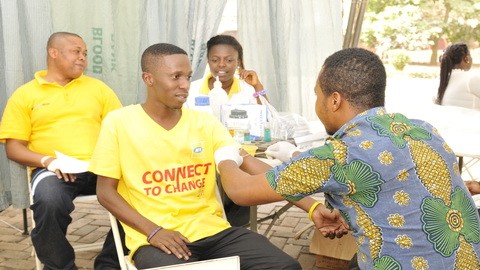
KINETIC ORGANIZES IT LEADERS WEST AFRICA SUMMIT 2012.The moderator for the event was Prince Baah-Duodu, founder, Cranchon. The opening address was by Ms. Sherry Ayitey, Minister for Environment, Science and Technology, Ghana. Some of the companies present were AIESEC and Telkom SA Limited. AIESEC thinks that student movement and innovation in IT is important, potential realization and talent development is equally very important as well as youth empowerment. They however, maintain that targeting is business and that is the sure way a company in this industry can create a niche for itself. Similarly, Telkom in 2010 had a diversification from fixed line to mobile operations. In 2011, however, Telkom Business Mobile was launched. Kinetic events needed a platinum sponsor to create a platform for multi-nationals so they contacted us, Telkom SA Limited. ICT value chain is very diverse. Telkom SA Limited brings an infrastructure to develop the connectivity and to enable its networks in Africa. Global Services posed a question to participants that which African countries do UNILEVER, AEL Mining, Standard Chartered Bank, Barclays Bank want to expand to in the coming years. IPL Cs, Global VPN, Terrestrial Infrastructure etc were present. The capacity of some IT African countries was identified. According to Telkom, MPLS Routers are to be developed in Ghana, Kenya and Tanzania. Telkom SA Limited says it is prepared to replicate the value chain. The company says it is has presence already in Ghana through African Online and I way Africa. It says however, that the company looks forward for businesses to be formed as well as new business collaborations. TE Connectivity or Taya Electronics as mostly called manufactures cables and hardware and other Fiber Optic Backbone. OEM, original equipment manufacturer represented in over 80 countries globally. It is multi-national in nature and has 100,000 employees. It has plans for Africa especially West Africa. Partnership with local companies ie. Software integrated companies mainly for distribution. Business development, Business partnership and knowledge sharing are key on the table with a 2 year plan. This plan is most important or timely. It is most important and timely. It is timely in ICT Manager, food and Agriculture. Telkom SA Limited involvement motivated me to participate. Nita involvement motivated me. However, there was lack of recognition, communication aspect was also lacking. In terms of convergence, it was generally agreed that initiative must come from Nita, to bring out a resolution or blue print to government. MDAs must be brought on board as well. These were among other issues discussed at the summit.
THE ENVIRONMENTAL PROTECTION AGENCY LAUNCHES GUIDELINES FOR ENVIRONMENTAL ASSESSMENT AND MANAGEMENT OF THE OFFSHORE OIL AND GAS DEVELOPMENT IN GHANA. The Environmental Protection Agency has on Friday, 30th November, 2012 launched the Guidelines for environmental assessment and management of the offshore oil and gas development in Ghana. It was launched at the Coconut Grove Regency Hotel here in Accra. The launch was very brief and concise with a welcoming address by Ag. Executive Director, EPA, witnessed by different stakeholders including the media. He mentioned in his speech among other things that the promulgation of the Environmental Assessment Regulations, LI 1652 in 1999 gave a comprehensive legal cover to the Ghana Environmental Impact Assessment procedures developed by the Agency in 1995. The objective of the LI, he says is to ensure that such developmental activities are carried out in an environmentally sound and sustainable manner such that the nature of the responsibilities of the different stakeholders are clearly defined depending on their statutory functions, areas of jurisdiction and interest such as policy makers, implementation or regulatory agencies, planning authorities, financial intermediaries or institutions providing training or consultants providing services in EIA. An important aspect of the programme was the development of Environmental Assessment Sector Specific Guidelines for eight sectors. At the time, the oil and gas sector was only that of the downstream activities. It was therefore included in the general energy sector. However, the key of oil and gas guidelines are, defining the screening criteria for environmental assessment for the oil and gas investments. Determining the scope of environmental impact assessment of the sector. Providing systematic procedures on environmental impact statement preparations for the sector and providing guidelines on common potential impacts and mitigation measures. The Executive Director mentioned among other things that, $51 million have been secured for a five year project and about $4 million going directly to fund activities of the EPA. The guideline will be a valuable tool for the EPA to assess the activities of oil and gas industry in Ghana. There are some strategies adopted by the EPA. These include, capacity building, collection of base line information, emergency response, etc. Again, 25 new staff have been recruited for training under this project. The government of Ghana entered into an agreement with the Norwegian government to provide technical assistant to a tune of $6 million. There was also an appreciation to the team of Norwegian professionals led by Mr. Jonny Auestad, programme Coordinator. The EPA also used the opportunity to launch their new website, which is www.epaoilandgas.org Story by Malise Otoo. RAHIMAFROOZ INTERVIEW ON ITS PARTICIPATION AT THE ECOWAS RENEWABLE ENERGY CONFERENCE.Rahimafrooz, an energy company in Bangladesh is in the country to participate in the Ecowas conference in Renewable energy and to look for an opportunity to partner a local company with financial capacity who may be interested the generation of renewable energy in Ghana. Bangladesh is located in the South East Asia, consisting of about 160 million people with a tiny plot of land almost 144,000 square kilometers. About 80 million people do not receive electricity from the grid, especially in rural areas. 70% people in the rural areas have no access to electricity. As far back as 1996, Rahimafrooz together with Grameen Bank started a project to take renewable energy to 80% of the rural people so that they could get the opportunity to change their lives and have development without harming the environment. Rahimafrooz provides Clean Development Mechanism(CDM), Voluntary Carbon Standard(VCS), Carbon Project Feasibility Study, Project Design & Development, Project Documentation, Facilitating Project Validation and Approval, Trading Carbon Emissions, Energy Auditing, Industrial Energy Efficiency solutions, Solar Energy Solutions among others. African Review Magazine engaged Mr. Sohel Ahmed, General Manager and Head of Business at RAHIMAFROOZ in an interview when the company participated in a just ended high powered conference on Renewable Energy organized by ECREEE, here in Accra, Ghana. African Review Magazine asked him the following questions. African Review of Business & Technology: HOW MANY HOUSEHOLDS HAVE YOUR SUPPLIED ELECTRICITY SO FAR SINCE 1996? Mr. Ahmed Response: As I have mentioned earlier, till now about 70 % of rural Bangladesh households do not have access to the electricity grid but we have been able to supply about 40% of the entire population. African Review of Business & Technology: WHAT ARE SOME OF THE KEYS PROJECTS RAHIMAFROOZ HAVE EMBARKED ON? Mr.Ahmed: We have developed the Solar Home System (SHS) for rural families. As you know, Bangladesh is a fairly hot country with sunshine throughout the year; therefore by owning a Solar Home System, a rural family can enjoy bright light, watch television, listen to the radio and power their mobile phones and can use light to study at night and do their homework.
African Review of Business & Technology: WHAT ARE SOME OF THE CHALLENGES AS REGARDS TO THIS PROJECT? Mr.Ahmed: One can say cost. Even though upfront cost seems high, once SHS is paid off, there are no additional costs and one can escape from the kerosene fumes, as Kerosene was used widely in rural Bangladesh. The challenge therefore was to convince rural people that Solar PV technology was a workable solution to their energy problem. African Review of Business & Technology: DOES RAHIMAFROOZ INTEND TO BRING THIS TECHNOLOGY TO GHANA SINCE BOTH NATIONS HAVE SOME SIMILARITIES? Mr. Sohel Ahmed: Certainly, we are looking at a possible investment by our company in the near future in the area of sustainable renewable energy. We would like to bring on board a local partner with a financial capacity to distribute our solar installations across the country. Ghanaians can expect more from Rahimafrooz. African Review of Business and Technology: HOW WOULD YOU ADDRESS THE ISSUE OF FUNDING AS RURAL GHANAIANS ARE MOSTLY POOR? The government and donors like the World Bank is expected to subsidize these installations of the SHS. In 2003 in Bangladesh for example, the World Bank provided funding for 50,000 SHS. The Infrastructure Development Company Limited was entrusted with the responsibility for this funding and selection process of identifying beneficiary companies in the renewable energy business. However, the customer needs to pay 15%down payment initially and the remaining balance spread in 36 months. Currently, there are 9 different systems with specific capabilities 20W, 30W, 40W, 50W, 65W, 75W, 85W, 100W and 130W.) 1.7 million Solar Home Systems have already been installed benefiting 17 million people. 60,000 SHSs are being installed per month.
ECOWAS-GFSE –GEF –UNIDO HIGH LEVEL FORUM ON RENEWABLE ENERGY. The Ecowas Centre for Renewable Energy and Energy Efficiency (ECREEE) has put together a high power packed energy conference here in Accra from the 29th – 2nd November, 2012 under the theme, “Towards Sustainable Energy for All in West Africa.” Paving the way through Renewable Energy and Energy Efficiency.” The conference begun with an opening address by M. Ebrima Njie, Ecowas Commissioner for Infrastructure followed by a welcome address by Hon. Joe Oteng-Adjei, Minister of Energy of Ghana who was introduced by the chairperson, Hon. Oluniyi Robin-Coker, Minister of Energy, Sierra Leone. There were several policy papers in Renewable Energy from different countries across the sub region including, Benin, Liberia, Ghana and Mali. After this, there was an adoption of a resolution to the Ecowas protocols regarding Renewable Energy and its efficient use. Then again, there was also a high level panel discussion after the lunch break which was chaired by the President of GFSE, Irene Giner-Reichl and another powerful welcome address by HE Kadre Desire Ouedraogo, Ecowas President. An address by Andris Piebalgs, EU Commissioner for Development was also read by himself to the expectant audience. Furthermore, there was a message from the UN Secretary General, Ban Kin Moon on SE4ALL read on his behalf by Kandeh K. Yumkella, Director General of UNIDO followed by a speech read by Ambassador Victor Gbeho, Ghana’s representative to Ecowas on behalf of HE John Dramani Mahama, President of the Republic of Ghana. The president said among other things that It was indeed a great honor and privilege for the Government of Ghana to host this important conference which will culminate in the adoption of two landmark regional policies and action plans in the area of renewable energy and energy efficiency, as well as a regional small-scale hydro power programme and that Ghana is committed to these important regional processes .He went further to state that Ghana in 2012 has passed the Renewable Bill into law to include the establishment of feed-in-tariffs. Again, he announced that Ghana is on track to meeting its universal access to electricity and energy by 2016 with our 'Energy to Every Home' programme. Between now and 2016, we have two critical milestones: * By the end of 2012, we will end the current load management exercise that was put in place as a result of interruption in gas supply from the West Africa Gas Pipeline Project; * By the end of 2013, Ghana's deficit in Energy supply will be significantly minimized, thereby largely eliminate the need for load management.These will be achieved by increasing power generation from 2,443 megawatts to 5,000 megawatts by 2016 through an active partnership with the private sector and improvement in transmission equipment. By 2020, to meet the demand of the iron industry and other large consumers by increasing power generation to 15,000 megawatts. Finally, he pledged that Ghana will continue to engage with investors to implement the targets contained in the regional renewable energy and energy efficiency policies. We also call on our regional development partners to sustain their support and join hands with us in this urgent task of ensuring universal energy access. They all mentioned that renewable energy is the way to go in the world, especially if Africa truly wants to take its real position in the 21st Century. Similarly, there was another discussion with several speakers across board on the same topic of Sustainable Energy for All but this time around it was chaired by Kandeh K. Yumkella, DG of UNIDO and Chair of UN Energy and moderated by Irene Giner –Reichl, GFSE President. The Austrian Ambassador, Dr. Michael Linhart delivered a paper in which he said that energy services are essential for alleviating poverty and increasing productivity, competiveness and economic growth. There were 15 exhibitors, 9 supporters, 3 organizers including Alliance for Rural Electrification from around the world in the area of renewable energy. There was an inaugural tour to the Off-Grid exhibition. It is no doubt that that renewable energy is the way to go in West Africa but how can stakeholders make sure that this energy is developed to provide jobs for our people? How can we ensure market equality? These are questions that in my opinion need some serious answers. UNIDO stipulates that it will develop renewable energy in the sub region in 4-5 years from now. They further mentioned that in 2016, all countries in West Africa will be connected. The timing is aggravating Nigeria citizens doing retail business in Ghana. Solar, Wind power and Biomass is set to be highly developed in Ghana in the next four years. It was generally agreed that renewable energy is economically viable in many context. Electricity coverage in Ghana, for instance is set to be 72% of a population of 24.3 million. It is however, projected that the country will generate 10% of electricity from renewable energy by 2020. It must be worth noting that Ghana recognizes that in other for the country to be global and competitive in the area of doing business in the world, it must improve and enhance her energy mix to attract more investors in this very challenging world. This, Ghana’s Minister of Trade and Industry, Hanna Tetteh makes very clear in her presentations. Indeed, small market, high risk perception and high financial cost according to Michael Franz, project manager, EU Energy Initiative Partnership Dialogue Facility (EUEI PDF) are some of the reasons investors shun away from investing heavily in the sub region in the area of sustainable renewable energy. But this perception is gradually being surmounted, he says. Frank Wouters, Deputy General of the International Renewable Energy Agency (IRENA), mentions that the organization with the Abu Dhabi Development Fund has put together a $50 million fund to accessed, Africa included to develop renewable energy. Training of PV entrepreneurs will also be done. Private investment is to be attracted in this regard. On his part, Mr. Ernesto Macias, Director of Alliance for Rural Electrification, says his outfit plans to promote, develop and distribute off-grid renewable energy solutions in Ghana. In an answer to a question posed by a correspondent from the African Review of Business and Technology about UNIDOs attempt to develop the use of renewable energy in the sub region and whether the set time is not too farfetched, Mr. Mahama Kappiah, Executive Director of ECREEE said 4-5 years is a lot time to develop the infrastructure and put in place these initiatives. Lastly, Mr. Seth Mahu, a Chief Director representing the Minister of Energy for Ghana, says the Government of Ghana have put measures in place to add about 5 megawatt of power by 2016 and has put a financial initiative in place to leverage funds for this take off. Again, 1 megawatt by come out of small hydro’s which the Ministry has identified. Wind Energy, Biomass and Solar which is relatively costly in the off-grid sector will be developed. $10 million have been injected in off-grid projects. 10,000 off-grid installations including schools, hospitals etc have been done. Wind power is currently been explored in the 200 islands that exist in Ghana. -Story by Malise Otoo. (Principal Correspondent, African Review Magazine). www.africanreview.com Twitter.@MaliseOtoo. listeningpostghana@hotmail.com. AFRICAN LEADERSHIP NETWORK CONFERENCE OPENS IN ACCRA.
The third annual African Leaders Network opens from today, 10th October-13th October, 2012 at the Movenpick Ambassadorial Hotel here in Accra. Over the next three days, the conference will see a gathering with interactions sections from members of the ALN and other entrepreneurs from across the continent. The conference has a morning session with an option for participant to choose between attending the Entrepreneurship Summit or the Investment Opportunities in Ghana session. Key and confirmed speakers at the conference includes Arthur Mutambara, Deputy Prime Minister of Zimbabwe, Hannah Tetteh, Minister of Trade and Industry, Ghana, Matt Bannick, Global Managing Partner at Omidyar, Chiwetel Ejiofor, a British Screen Actor, Patrick Awuah, Founder and President of Ashesi University, Arnold Meyer, CEO of Rendeavor among others. Speaking on the topic, Investment opportunities in Ghana, Trade Minister Hannah Tetteh, mentioned that there are various opportunities in Oil and Gas, Agriculture, Trade, Telecommunication, Services, Infrastructure etc but were quick to add that government is not in a position to fund SMEs and therefore cannot tell Banks where to put their investment. A cocktail followed in the evening where lots of networking was done amongst stakeholders. A gala dinner and Africa Awards for entrepreneurship ceremony is expected the following evening, 11th October, 2012. In an interview with Dr.Shannon May, a Finalist for the SME Award and CEO of Bridge International Academics, based in Nairobi, Kenya. Her firm started operations in 2008 with a vision of providing quality education to the girl child. Again, her firm has employed 1100 people since starting operations. The company however, is looking at the possibility of starting business in Nigeria. It can be considered as possibly one of the fastest growing businesses in Africa. Again, also in the list of finalists for the Large Enterprises is Mezni Jalila of Tunisia who owns a business called S.A.H Group with a brand name called Lilas producing a wide range of baby diapers, tissue etc. Her business as she mentioned started in 1993. 60% of her market is in Mauritania. She operates from about 27 countries across Africa in countries like Morocco and Libya. During the discussion session on China in Africa, a lot was discussed about the prospect of China in Africa in the area of business. A representative of China Exxon Bank, Dr. Jan suggested that Africa must develop pragmatic leaders, good entrepreneurial cultivation because in their case, China encourages innovative ideas even at the top level of governance. A representative also from the Africa Career Network suggested to participants a portal for recruiting the expertise that Africa needs in this 21st Century. Another representative from Attics a private equity firm from the USA, put to participants their readiness and preparedness to provide funding for SMEs in Africa to grow and mentioned that Private Equity Business must help develop Africa.
INTERNATIONAL INVESTMENT CONFERENCE. Theme: “Boosting Investments in sustainable Forestry, Forest Carbon and Renewable Energy.” According to Michael Jenkins, CEO of Forest Trends and moderator at the conference, “A national emission scheme must be developed by Ghana.” He made this suggestion during the conference at the Lapalm Royal Beach Hotel in Accra. Perhaps this can be lined to the already existing module of the Environmental Protection Agency (EPA). Again, Jane Feehan, a representative of the European Investment Bank and a natural resources specialist made mentioned that the first partnership agreement on illegal logging was first signed with Ghana and the EU. Thus, Ghana became the thrill blazer in this regard. She went on further to state that the EIB Bank is ready to invest in Ghana’s economy as well as provide funds in the form of venture capitals to local companies whose core values is to create environmental awareness on climate change. The EUs effort to tackle illegal logging must be emphasized. One can safely say that funding is good. However, at the end of the day, do multinationals consider the sustainability of these projects towards contributing positively to preserving the environment? There is sometimes a lack of understanding of the requirements from multinationals to these local companies. Furthermore, projects must comply with the equator principles to meet standards regarding the environment. Companies on their part demand greater transparency in the selection process but in a sharp rebuttal, multinationals reassured that due diligence is done on projects proposals and said that sustainability is key and must be around as long as the project is around. -Story by Malise Otoo.
GHANA'S EXTRACTIVE INDUSTRIES TRANSPARENCY INITIATIVE REGIONAL CONFERENCE HAS BEEN HELD. The Ghana Extractive Industries Transparency Initiative has organised this years Regional conference on the theme,"Natural Resource Governance,Setting standards with EITI." The conference was held from the 27th-28th September, 2012 at the Lapalm Royal Beach Hotel. Participants were drown from Government ministries, the private sector, civil society, chiefs among others.Deliberations included the need to improve the standard on the governance of effective EITI strategies. The program begun with a brief address by the chairman, Naa Prof. John Nabila, President of the National House of Chiefs, Ghana where he mentioned that EITI was announced by the then British Prime Minister Tony Blair. Ghana, Nigeria, Azaberjan led the way in its formation.35 countries adobted it thereafter. The initiative was therefore formed in South Africa in 2002.He however mentioned that,"Information is the basis of a well functioning system." Again, open remarks were made by the Deputy Minister of Lands and Natural Resources, Hon Kwadwo Owusu-Agyemang on behalf of the Minister of Finance, Dr.Kwabena Duffour where he mentioned among other things that the extractive industry contributes about 12.7% of GDP,2.3% of corporate tax and has 27,000 people working in the sector. 500,000 people are engaged in small scale mining in this country alone. A number one finds frightening. He went further to state that the Mining Revenue Management Act has come to the notice of government and is currently being considered by cabinet. If passed by parliament, Ghana will now have a revenue management act which will see the mining development fund come into force just like the Petroleum Revenue Management Act. But he was quick to add that "EITI is not a magic bullet." He suggested further that a legal framework must be developed to ensure that all actors in the industry play by the rules of the game. In her closing remarks for the conference, Dr.Esther Ofie-Aboakye speaking under the topic, establishment of regional EITI co-operation suggested the creation of a continental body to increase the frontiers of the activites of all EITIs in a collaborated effort toward sustainability. -Story by Malise Otoo.
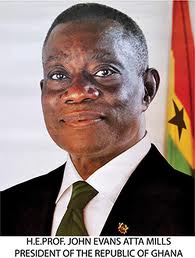 Ghana’s President John Mills Dead.
The West African state of Ghana has been thrown into an atmosphere of mourning following the death of her president John Evans Atta Mills yesterday July 24. The 68 year old passed away at exactly 2:15pm local time at the country’s premier military hospital, the 37 Military Hospital, located in the Capital, Accra. Sources at the presidency say he was rushed to the hospital on Monday evening after complaining of severe pains. A full autopsy report on his death is yet to be made public. His death comes few weeks after he had travelled to the United States of America for a routine medical check-up, amidst concerns from a cross section of the Ghanaian public about the true state of his health. Chief of Staff at Ghana's seat of presidency Henry Martey Newman confirmed the sad news on Tuesday afternoon. “It is with a heavy heart and deep sorrow that we announce the sudden and untimely death of the President of the Republic of Ghana - His Excellency, Professor John Evans Atta Mills,” he said in a terse statement. “The death occurred at the 37 Military Hospital this afternoon while receiving medical attention after being taken ill a few hours earlier”. Atta Mills becomes the first Ghanaian head of state to die while serving his term in office. He was survived by his wife of long-standing and first lady of the Republic of Ghana, Ernestina Naadu Mills. John Dramani Mahama, who until yesterday afternoon was the Vice President, has been sworn in as President in accordance with the West African country’s constitution. He has thus assumed official, executive and constitutional powers as head of state, and is to lead the country for the next five months before elections are held. Ghana goes to the polls in December to elect a new leader, in what was originally a straight and cut-out election between John Atta Mills and the opposition leader Nana Addo Dankwa Akuffo-Addo. Atta Mills became president of Ghana in 2009 after the National Democratic Congress took over the reins of the administration of the West African country from the National Patriotic Party, who was in power for eight years He is the third and current President of the Fourth Republic of Ghana. He was inaugurated on 7 January 2009. He was awarded a PhD at age 27 after successfully defending his doctoral thesis in taxation and economic development. A law lecturer at the University of Ghana for many years, he became a visiting professor of Temple Law School (Philadelphia, USA). He also authored several publications relating to taxation. In astute public servant of repute, Mills was the Acting Commissioner of Ghana’s Internal Revenue Service from 1986 to 1993, and became the substantive Commissioner from 1993 to 1996. He served as Vice President of the Republic of Ghana from 1997 to 2001, deputing for former president and founder of the National Democratic Congress Jerry John Rawlings. In 2000, Mills became the NDC’s candidate for the Presidential elections after Jerry Rawlings had served his constitutionally mandated term as president. He however lost out to the NPP’s John Kufour. 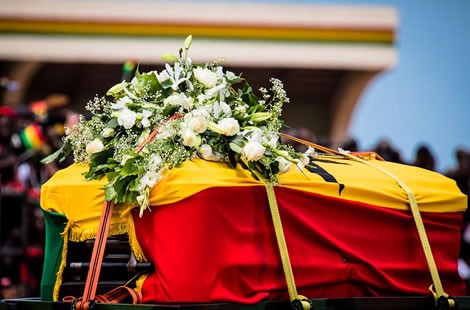 FUNERAL OF H.E PRESIDENT EVANS ATTA MILLS HELD.The funeral of H.E John Evans Atta Mills have been held in Accra from wednesday,8th August,2012 -10th August,2012 at the State House and Independence Square.The funeral according to the Funeral Commitee put together by the government was to commenced on wednesday morning at around 9am with a filing pass the body by the current President H.E John Dramani Mahama and First Lady,H.E Lordina Mahama, Former First Lady,Dr.Ernestina Naadu Mills and son of the President, Kofi Sam Atta Mills,aged 21.The commitee also mentioned that it is expected that about 16 Head of States from across the world is expected to attend. The dignatries together with the Council of State, Former Presidents and their spouses filed pass on wednesday. Others included Members of Parliament, Representatives of other political parties, the clergy, judiciary, the representatives of the muslim community etc.At about 1 pm, members of the public was given an opportunity to file pass the body until 7pm, wednesday, 8th August,2012. An estimated number of around 5000 people filed pass His Excellency, the president.A vigil was organised that evening until 12 am at dawn. An opportunity was again given to the general public Thursday, 9th August to file past the body of the late president which was layed in State at the Banquet Hall of the State House. Tons of thousands of people thronged the State House to pay their last respect with Ghanaians queing as early as 3 am to get an opportunity, perhaps this signify how valuable the President was to them and the deep love they wish to show to him though he is no more.President Mills died at the 37 military hospital, Tuesday, July 24, 2012 after a short illness. He was 68. The official day for the Funeral which was Friday, 10th August was declared a public holiday.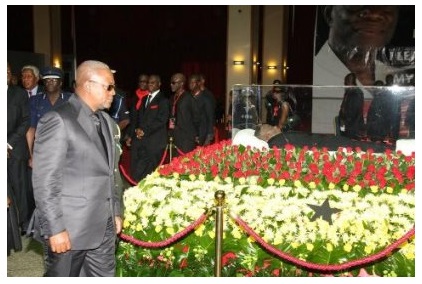 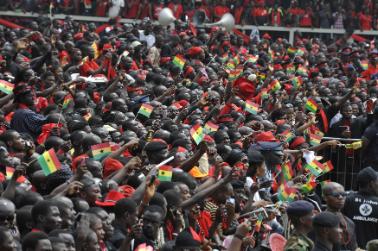 |
ARCHITECTS REGISTRATION COUNCIL OF GHANA SEMINAR ON SENTISIZING AND ADVOCACY FOR THE USE OF LOCAL BUILDING MATERIALS (LBM). The Architect Registration Council has held a 2nd Local Building Materials seminar here at the Holiday Inn, Accra on the 30th July, 2013. The seminar was to indicate the readiness of key built environment players to accept and explore local building and construction materials. In view of this, there were two key presentations at the seminar which included Alternative binders for increased sustainable construction in Ghana from the Pozzolana Ghana Limited and another on Compressed Earth Blocks by the Depart of Rural Housing. Pozzolanic cement is a mix of natural and industrial Pozzolana and Portland cement. In addition to underwater use, the high alkalinity of Pozzolana makes it especially resistant to common forms of corrosion from sulfates. According to the Sales and Marketing Manager, Mr. George Ofori, Pozzolana Cement goes through three stages before going to market. These comprise of the Development Stage, the Research Stage and Commercial Stage and the cement does not hydrate. Pozzolana had to be used with other cements to achieve better results. When mixing pozzolana cement, you need to look at the OPC type either 42.5n or 42.5r, that is, clay pozzolana and hand-mix concrete ratio is 75% OPC and 25% Pozzo. Thus, three 50kg OPC is to one bag of Pozzo to get the desired results. Furthermore, when it comes to blocks, you would have to use about 66% of OPC and 33 % pozzolana, which is 2:1 and this will help replace one head pan of OPC with equal measure of pozzolana. Some of their customers include, AESL, State Housing Corporation, Micheletti, Consar, HFC Realty, Vanguard Assurance, Atlantic Hotel, Bafia Blocks, Chase Petroleum, Bragha Construction, etc.
Pozzolana use helps the contractor to save up to 14% on the cost of OPC and the company’s factory is at Gomoa Mprumem, Winneba and the product can be bought from their distributors across the country. Currently, 4,000 bags of Pozzolana Ghana Limited are producing below capacity 4,000 bags of cement per day due to less demand. Similarly, the use of Compressed Earth Blocks was also discussed by Mrs. Deborah Kuwornu from the Department of Rural Housing. She mentioned that 3000psi is applied in compression. Stabilized CEB may consist less than 5% cement. However, soil or laterite is a main material component. The mix preparation includes sieving, batching and mixing. Compaction is also done, and then post production. Currying for 7 days makes the bricks strong and ready to use. The bricks can be used for foundations and walling also and has been tested by Ghana’s Ministry of Tourism at their receptive facility at the Eastern Region. In a related development, the Minister for Water Resources, Works and Housing mentioned that in December, 2011, a project to develop the use of Local Building Materials was launched and its center set up in Kumasi in the Ashanti Region of Ghana with the aim of achieving several factors like the retention of capital, employment creation, providing opportunities for local producers and improving engineering. An amount of about GH₡100,000 was set aside for this purpose. At the end of the seminar, it was resolved that Government must support the use of Pozzolana Cement and Compressed Earth Blocks with some incentives and financial support and for the companies also to revise their marketing strategies. Story By, Malise Otoo. Broadcast Journalist/Columnist, Construction Review Magazine. NEST OF IDEAS CONSULTING LIMITED ORGANISES LEADERSHIP EXCELLENCE WORKSHOP. Nest of Ideas Consult has ended its Leadership Excellence Workshop here in Accra. The workshop was held from the 14th to 16th May, 2013 at the Cleaver House here in the Capital. The workshop saw various participants from corporate Ghana like VRA, Golden Tulip, Joy FM, IFS, Angel Data Computer Limited, AGI, among others with the facilitator being Mrs. Margaret Takyi-Micah, management expect and CEO of the company.Some topics discussed included employee motivation, time management, conflict management, discovering ones spirituality and sexuality, delegation, performance appraisal, team dynamics and team building etc.According to the facilitator, it is always good to motivate employees for their good deeds through praise in public, day-offs after delivering excellent projects, use of pictures to announce their performance or even cash. In the area of conflict management, she said that, “yesterday’s conflict if not managed will become todays conflict and todays if not dealt with will become tomorrows.” During conflicts in a work place, there may be a tendency to be resentful if not checked. The word conflict resolution as used in the Ghanaian context is used erroneously. The right word is Conflict management. In conflict situations, the real approach should be problem solving and negotiations. There may be different types of conflicts in a work environment. These include Interpersonal Conflict and Intergroup Conflict, which may involve line and staff, production and marketing, etc. In solving these conflicts, we must improve communication, we must avoid friction. “Conflict that is managed properly can be beneficial.”-Mrs. Takyi-Micah, CEO, Nest of Ideas. In interpersonal relationships, we will always have issues to deal with. Sometimes, some of these interpersonal relationships come about due to external factors such as poor communication. However, attitude plays an important role in conflict management. Divide and role tactics is always a recipe for disaster and not good in conflict management. The topic of team dynamics and Team building was also discussed. The working of a team is what is described as team dynamics. Friendship in a team must be professional. A question was asked about what stage is my current team? Participants were given the various stages such as forming, storming, norming and performing stage. Each participant had a unique stage with regards to his or her team. Lastly, there was a discussion about Constructive team building. A constructive team, according to the facilitator must have about nine elements including collaborative, patience, flexibility, assertiveness, endurance, creativity, commitment, honesty and appreciation. The conference ended with presentation of certificates to participants. Story By, Malise Otoo. GHANA INSTITUTE OF ARCHITECT ANNUAL GENERAL MEETING. The Annual General Meeting of the Ghana Institute of Architects has been held here in Accra on the 15th of February, 2013. In his opening remarks, the secretary for the institute mentioned among other things during his report of activities of council from April, 2012 to January, 2013 that the GIA and Architect Registration Council has signed a joint –venture Company named Architect House Limited. Again, a fourteen floor mixed residential /commercial development is to be expected this year. Forty-eight apartments, commercial, rental floors and a two floor basement parking is to be constructed. Furthermore, there were several product presentations including one on Alternative Energy by Appliance Masters where they introduced solar power as an alternative means of generating power to augment the current power crisis. According to Appliance Masters, Ghana’s Hydro Power including Bui is 2.5 GW while Germanys Solar PV alone is 7.5 GW. A situation, which is currently very topical and worrisome in the country, needs the government and general public to embrace Solar. Similarly, MSF, a building construction firm from Portugal that was recently into the construction of the N1 Highway here in Accra gave a presentation on building and construction and the state-of-the-art technology they use from Portugal haven been set up since 1969. Another interesting presentation was the presentation by Sandtex on Antibacterial and Fire Retardant Paints. The Marketing manager mentioned in his presentation that a new product called Crown Paint from one of their partners from the UK has been developed one as an antibacterial paint and the other a fire retardant paint which is very good for building’s and any form of construction. He mentioned that the paint cost GH₵167 per 5 liter paint. There was an adoption of the Bye-Laws which was developed in 2001. An open forum also took place with members voicing out their grievances while upcoming activities for the year 2013 was also discussed. DoITBest, a retail company from the US gave a presentation to members about their assorted products ranging from lighting to furniture etc. Another Airport is set to be built in Accra somewhere around Prampram, the secretary revealed in a statement. Architect Adotei Brown, President of the institute, Architect Charles Dzogbenuku-Vice President, Architect Eric Banful-Quaicoe-Public Relations and other members of the Board were introduced to GIA members. -Story By Malise Otoo.  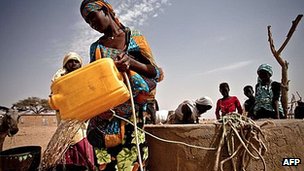  Drought has hit a huge swathe of the Sahel region.
Oxfam warns of West Africa drought 'catastrophy. Urgent action is needed to stop drought in West Africa's Sahel region turning into a humanitarian disaster affecting 13 million people, Oxfam says. The charity says the international community waited too long to respond to famine in East Africa last year. Oxfam has launched a £23m ($36m) emergency appeal to help reach more than a million of the most vulnerable. A BBC correspondent says refugees fleeing fighting in northern Mali are adding to the problem. Launching its appeal, Oxfam said that malnutrition rates across Chad, Burkina Faso, Mali, Mauritania, Niger and northern Senegal are hovering between 10% and 15%, and in some areas have risen beyond the emergency threshold level of 15%. It says that more than one million children in the Sahel region are at risk of severe malnutrition. In parts of Chad, Oxfam says, some villagers are digging up ant hills to gather grain that the ants have stored. The agency says that drought, high food prices, severe poverty and regional conflict are causing the crisis. "Millions of people are on the threshold of a major crisis," said Mamadou Biteye, Oxfam Regional Director for West Africa. "All signs point to a drought becoming a catastrophe if nothing is done soon. The world cannot allow this to happen. A concerted aid effort is needed to stop tens of thousands dying due to international complacency." He added: "We witnessed last year the situation spiraling out of control in East Africa as the aid community failed to act swiftly. The worst can be avoided and thousands of lives will be saved if we act now. It's that simple." BBC world affairs correspondent Mike Wooldridge says that recent fighting between rebels and the army in northern Mali has caused more than 100,000 people to flee their homes - half of them crossing into Niger and other countries that are already hard-pressed. In January, Oxfam and Save the Children said that thousands of people in East Africa died needlessly from famine last year because the international community failed to heed early warnings.
The Top 5 Richest Africans over the Next Decade.In years to come, Africa's wealthy elite will continue to dominate the territories they command now - this is what their current fortunes tell us. In many parts of Africa, personal wealth comes with great responsibility. Individuals who control a country's major industries are responsible for providing jobs for thousands of households, and generally influencing the territory's economy in a significant manner. For these elite few - the men who are consistently ranked among the world's richest people - sustaining their substantial wealth is as demanding as the effort it required to create it in the first place. In the league of Africa's rich men, there is no such thing as small money, and also, there is no such thing as 'Once rich, always rich'. We profile five of Africa's richest men and find out who is most likely to increase their fortunes over the next decade - and who will give the most back. Aliko Dangote – Nigeria
Aliko Dangote - Nigeria Dangote's wealth is currently pegged at around $10.1 billion, most of which was generated through investments in sugar, flour, and cement. The 54-year-old father of three is currently the continent's richest man, according to Forbes magazine. Two years ago, Dangote Cement was listed on the Nigerian Stock Exchange, and that has since helped swell his fortunes further. So how does the Dangote story go? There are tales of how he started off with a loan from his uncle, and from there went on to spearhead the growth of the Dangote Group. Dangote is a committed philanthropist who continues to invest heavily in many social issues, including providing healthcare and access to quality education. Dangote has demonstrated beyond measure that his wealth won't fade away - at least not in the next decade.
Theophilus Danjuma - Nigerian Danjuma is thought to be worth about $600 million, largely derived from his holding in South Atlantic Petroleum (SAPETRO). Danjuma is one of the continent's richest men and with the rising price of oil, his fortunes increase every day. Danjuma, the former Defense Minister of Nigeria, was ranked as the 21st richest man in Africa, according to Forbes. His charity trust, the TY Danjuma Foundation, continues to offer hope to thousands of households. Currently, he advises the Nigerian government on official, state and government matters.
Cyril Ramaphosa - South Africa Ramaphosa is a former National Union of Mineworkers activist, and is now thought to be worth in the region of $275 million, generated through a wide range of investments. The 59-year-old owns the Shanduka Group, an investment holding company that has stakes in mining, banking, real estate, insurance, and telecoms, among others. Ramaphosa is well-liked across the continent for his business acumen, which has and continues to be a template for many other business start-ups. Mike Adenuga - Nigeria Adenuga's wealth is estimated to be around $4.3 billion - but this figure has been debated by his aides. Adenuga amassed his substantial fortune through business interests in telecommunications, banking, and oil. The 58-year-old is appreciated across the African continent for turning Globacom, his telecommunicationd ns holding company, into a global giant. Today, Globacom operates in four African countries, and is rated as one of the fastest growing multi-national carriers in the world. Outwardly a calm and reserved individual, Adenuga is said to have had made his breakthrough in business by selling traditional clothes made of Nigerian lace. He is also said to have benefited under the regime of former Nigerian leader Ibrahim Babangida, who awarded Adenuga contracts to execute huge infrastructural projects. Patrice Motsepe – South Africa
Patrice Motsepe - South Africa The 49-year-old Motsepe is worth an estimated $2.5 billion. He is said to be South Africa's first and only black billionaire. His wealth is largely derived from mining. Motsepe trained as a lawyer, but later went into mining, buying unprofitable mine shafts and turning them into revenue-generating ventures. Having benefited from South Africa's Black Economic Empowerment (BEE) laws to secure mining licenses, Motsepe saw his stock rise substantially over time. Last year, he was rated the 10th richest man on the continent, out of a list of 40 put together by Forbes. -Story by Malise Otoo. |